AFP to VP: Defending PH rights isn’t ‘picking a fight with China’
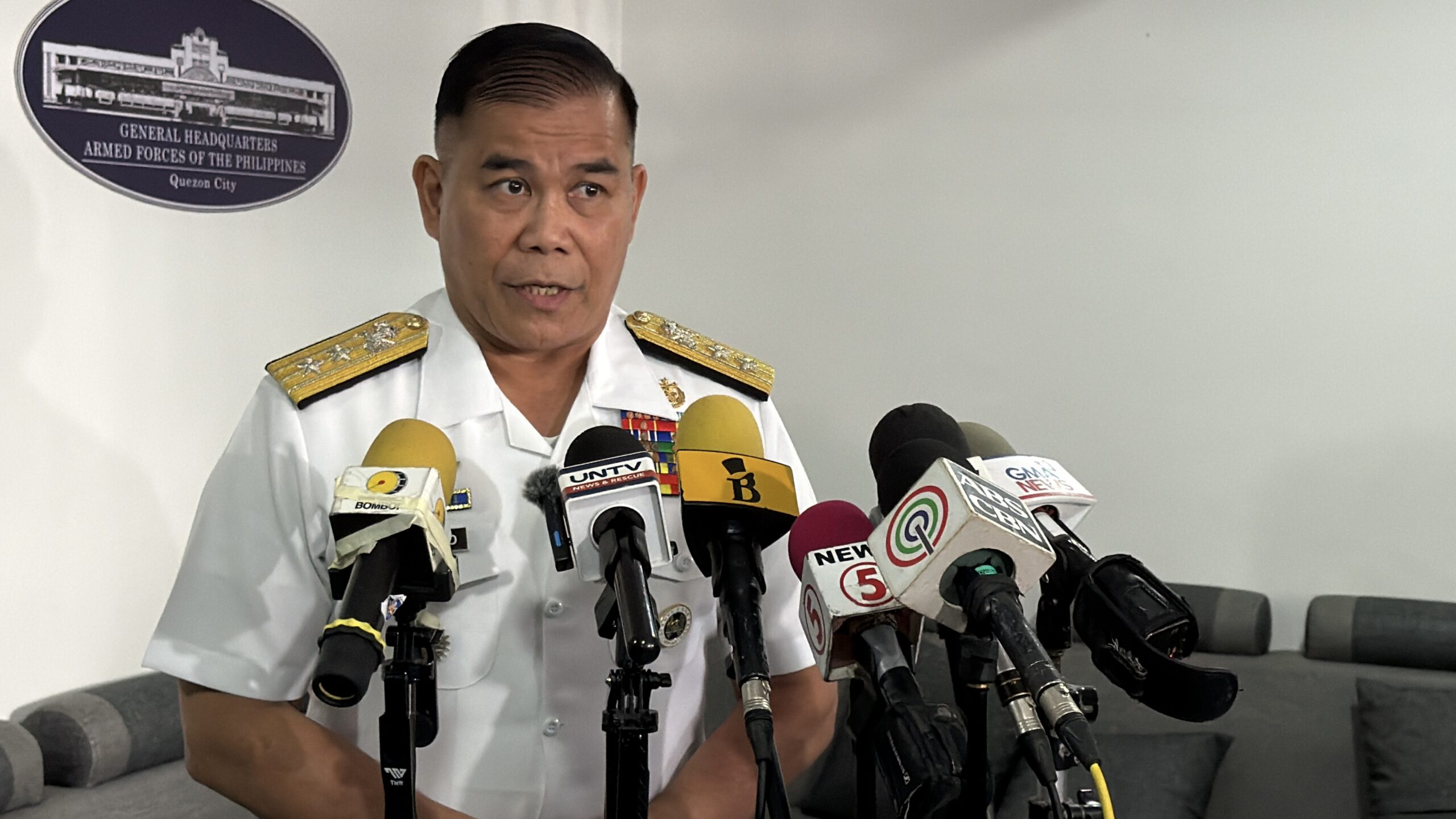
MANILA, Philippines — The Armed Forces of the Philippines on Tuesday said defending the country’s rights in the West Philippine Sea (WPS) did not amount to picking a fight with China, following Vice President Sara Duterte’s call for the government to avoid confrontation with Beijing.
Rear Adm. Roy Vincent Trinidad (Reserve), the Armed Forces of the Philippines’ spokesperson on matters relating to the West Philippine Sea, said he agreed with the Vice President that the Philippines should not antagonize other countries but stressed that asserting its maritime rights was a separate matter.
“We are not picking a fight with any country over the West Philippine Sea,” Trinidad said in a press briefing at Camp Aguinaldo. “By merely standing up for what is rightfully and legally ours, we are not fighting any other country.”
READ: VP Sara Duterte doubles down on China issues
Trinidad was responding to Duterte’s remarks during a gathering with overseas Filipino workers in Hong Kong on Sunday, where she urged the government to maintain good relations with China despite the maritime dispute.
The Vice President warned that deteriorating bilateral ties could threaten the jobs and businesses of Filipinos working in China. She also called for a team of diplomats and negotiators to handle the dispute rather than resorting to confrontations at sea or exchanges on social media.
READ: Marcos wants South China Sea code of conduct finalized during Asean
She further cited the disparity between the two countries’ military capabilities, arguing that the government should consider the consequences of confronting a more powerful neighbor.
Performing mandate
Asked about Duterte’s comparison of the Philippines’ military strength with China’s, Trinidad said the AFP would continue performing its mandate regardless of its capabilities.
“It is not about military strength. We have what we have. We are improving our capabilities,” he said. “Given what we have, we are good. Given more, we could perform even better. But it will not stop the AFP from fighting, from standing up, from supporting all our government officials who stand up for our rights in the West Philippine Sea.”
Trinidad also stressed that every Filipino, including elected officials, has a responsibility to defend the country’s national interests.
“The Arbitral Tribunal of 2016 is a legal landmark that upheld the maritime entitlements of the Philippines. Every Filipino should champion this,” he said.
The 2016 arbitral ruling invalidated China’s sweeping maritime claims in the South China Sea, although Beijing has refused to recognize the decision.
Trinidad maintained that the Philippines had not instigated tensions in the disputed waters, citing China’s construction of artificial islands and what he described as its “coercive and aggressive actions.”
Distinct roles
Trinidad also said the AFP would not scale back its activities in the West Philippine Sea despite calls to preserve diplomatic space for talks with Beijing.
Asked whether the military should tone down its assertion of Philippine maritime rights to give diplomacy a chance, Trinidad said the Department of Foreign Affairs (DFA) and the defense establishment had distinct responsibilities.
“We leave the statement of the [DFA] at that inasmuch as they are the primary vehicle of government for diplomacy,” he said.
“On the side of the [Department of National Defense] and the AFP, we have a mandate to perform to secure the integrity of the national territory, protect our sovereignty, and look after the welfare of the Filipino people,” he added.
The DFA earlier reminded officials, particularly members of the defense and security sector, to align their statements and actions with President Marcos’ foreign policy direction, particularly with regard to China.
In a statement on Sunday, the DFA stressed that the President, as the country’s chief architect of foreign policy under the Constitution, has the authority to determine the direction of the Philippines’ international relations, and that individual officials and government agencies cannot independently pursue their preferred approaches toward foreign partners.
“Whatever personal convictions public officials may hold, their public platforms carry institutional responsibilities. They may not pursue preferred approaches toward China, or any other international partner, without regard for the consequences on the government’s overall policy,” the DFA said. /cb
The post AFP to VP: Defending PH rights isn’t ‘picking a fight with China’ appeared first on Inquirer.net.