Marcos faces balancing act at Apec summit in China
MANILA, Philippines — President Ferdinand Marcos Jr. should prioritize trade, investment, and regional economic integration at the 33rd Apec Economic Leaders’ Meeting in China, moving beyond geopolitical issues to advance the Philippines’ interests.
China is the world’s second-largest economy by nominal gross domestic product (GDP) and the largest by purchasing power parity. Hosting the Apec meeting will help set the tone for how member economies pursue economic growth and cooperation.
READ: Marcos to CEOs at Apec Summit: ‘PH open, ready, and eager’
After concluding the Philippines’ hosting of the Association of Southeast Asian Nations Summits and Related Summits on Nov. 17 in Manila, Marcos will fly to China’s “Silicon Valley,” Shenzhen, on Nov. 18 to represent the nation at the economy-centered meeting.
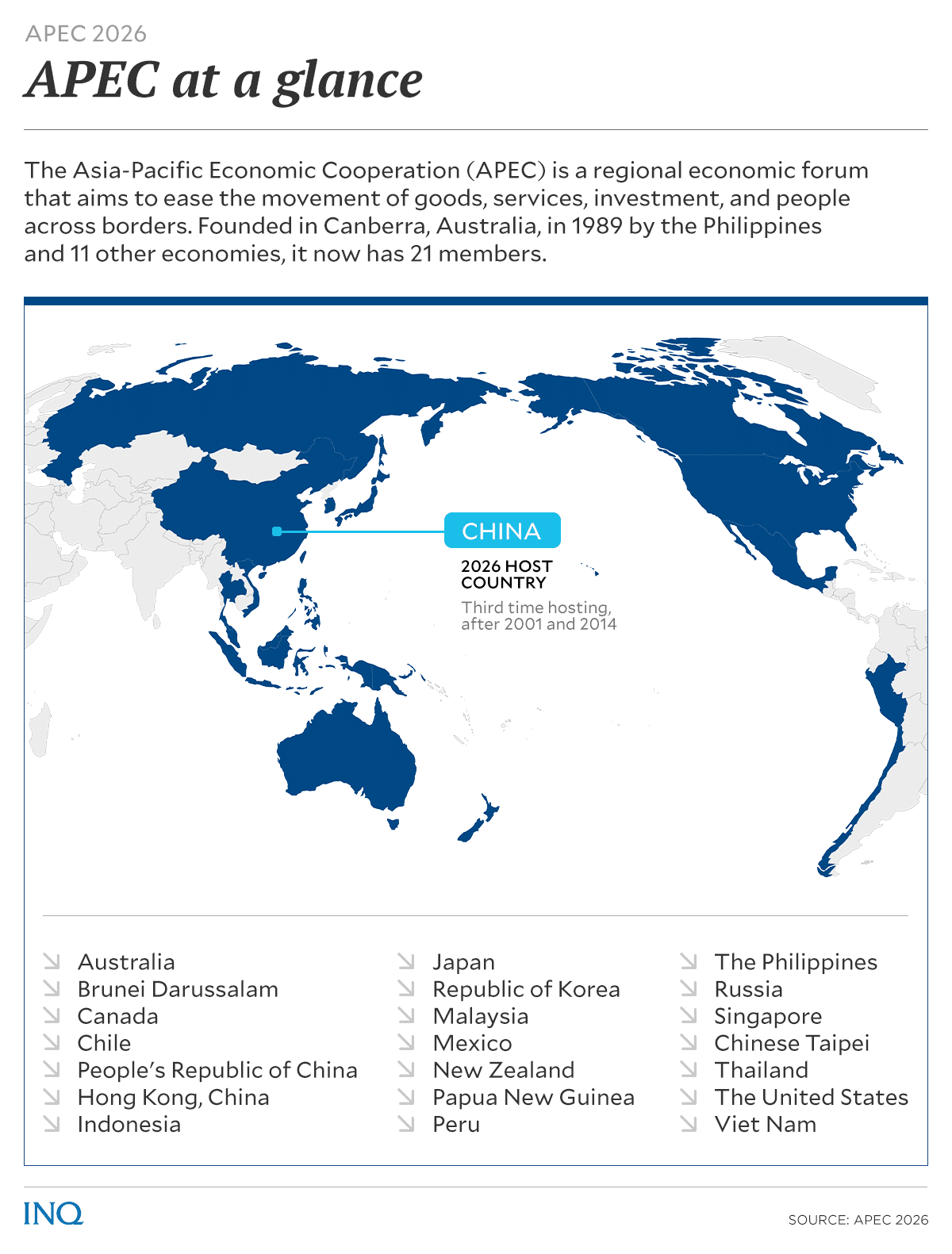
APEC at a glance
Apec serves as a regional economic forum that leverages the growing interdependence of the Asia-Pacific. It aims to ensure that goods, services, investment, and people move easily across borders.
In November 1989, the Philippines and 11 other founding countries—Australia, Brunei Darussalam, Canada, Indonesia, Japan, South Korea, Malaysia, New Zealand, Singapore, Thailand, and the United States—established it in Canberra, Australia.
Hong Kong, China, and Chinese Taipei joined in 1991, followed by Mexico and Papua New Guinea in 1993, and Chile in 1994. Four years later, Peru, Russia, and Viet Nam joined as well, bringing the full membership to 21.
READ: PH attains ‘upper middle income’ rank – World Bank
Between 1989 and 1992, leaders only met through informal senior official- and ministerial-level dialogues. The following year, former US President Bill Clinton established the practice of holding an annual Apec Economic Leaders’ Meeting to provide greater strategic vision and direction for regional cooperation among member countries, also referred to as “member economies.”
This year marks China’s third time hosting the meeting, following Shanghai in 2001 and Beijing in 2014.
Apec chose Shenzhen, a major technology and manufacturing hub in South China, as its host city. What started as a humble fishing village has transformed into an economic and technology center. Now, it will showcase China’s economic modernization, technological prowess, and reform and opening-up policy.
Key points of discussion
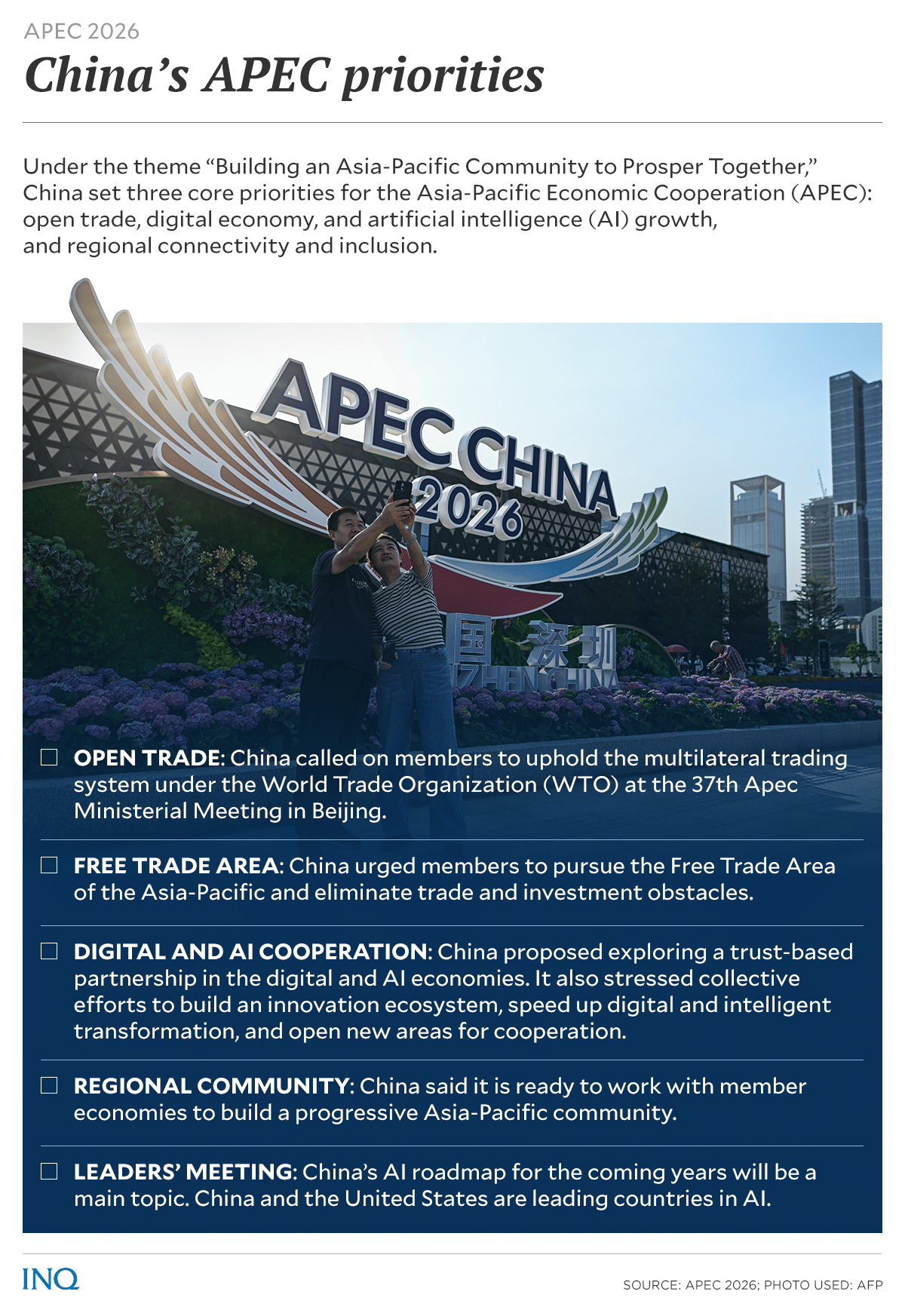
Under the theme “Building an Asia-Pacific Community to Prosper Together,” China set the core priorities: open trade, digital economy and AI growth, and regional connectivity and inclusion.
At the 37th Apec Ministerial Meeting in Beijing, Chinese Foreign Minister Wang Yi said China is ready to collaborate with member economies to build a progressive Asia-Pacific community.
READ: China, ASEAN make progress on SCS pact but can’t finish talks this year
The 21 Apec member economies account for around 61 to 62 percent of the global gross domestic product. In this context, Wang called on members to uphold the multilateral trading system under the World Trade Organization.
He also underscored the importance of collective efforts to build an innovation ecosystem, accelerate digital and intelligent transformation, and open up new areas for cooperation.
2026 APEC priorities
For his part, Commerce Minister Wang Wentao said member economies should pursue the Free Trade Area of the Asia-Pacific and eliminate trade and investment obstacles.
Additionally, he said member economies should explore a trust-based partnership in the digital and AI economies.
China, along with the United States, is a leading country in AI, and its roadmap for the years ahead will be a main topic at the leaders’ meeting.
Itinerary and attending officials
Various meetings have already occurred ahead of the leaders’ meeting on November 18 to 19. These include the 2026 APEC Finance Ministers’ Meeting held in the Hong Kong Special Administrative Region and the 12th Apec Transport Ministers’ Meeting in Beijing.
The 4th Apec Business Advisory Council Meeting runs from November 14 to 16, followed by the Apec Ministerial Meeting on November 16 and 17 and the APEC CEO Summit on November 17 and 18.
READ: AFP to VP: Defending PH rights isn’t ‘picking a fight with China’
Like Marcos, US President Donald Trump will head to Shenzhen after the 49th Asean Summit for potential bilateral talks with Chinese President Xi Jinping.
Similarly, Russian President Vladimir Putin, Japanese Prime Minister Sanae Takaichi, and South Korean President Lee Jae-myung will also reportedly attend the event.
While details of Marcos’ agenda on the sidelines of the Apec Leaders’ Meeting have yet to be provided, the public is watching for the possibility of bilateral meetings with Xi and Trump, although these remain long shots.
To recall, Marcos met with the host country’s leader, Lee, during the 32nd Apec meeting in Gyeongju, South Korea, in 2025.
Also, Marcos will likely use the economy-focused Apec CEO Summit to woo investors to the Philippines amid global turbulence.
What to watch
Member economies will release an Apec Leaders’ Declaration, a document that outlines their collective agreements, commitments, and strategic goals.
They will also announce their commitments on regional trade and investment while updating the public on the agreements reached regarding AI and digital trade.
Meanwhile, the public eagerly anticipates hearing about the concerns Filipino businesses raise regarding regional economic integration and whether Marcos will address maritime issues during his meetings. /pai
The post Marcos faces balancing act at Apec summit in China appeared first on Inquirer.net.